

North Carolina Eminent Domain & Land Condemnation Attorneys
Contact our eminent domain attorneys:

If you’ve found yourself facing the daunting prospect of losing your property to eminent domain, you’re not alone. At Kirk, Kirk, Howell, Cutler & Thomas, our team of eminent domain attorneys in Raleigh, NC, understands the stress and uncertainty that often comes with a taking.
Our Raleigh, NC lawyers help property owners understand their rights and potential defenses in eminent domain and land condemnation matters throughout North Carolina. Our goal is to provide clear guidance from the first notice through negotiations or trial, so you can move forward with a plan.
North Carolina Eminent Domain & Land Condemnation: Quick Answer
Eminent domain is the government’s authority to take private property for public use when required legal procedures are followed and just compensation is provided. Land condemnation is the legal process used to acquire the property.
Kirk, Kirk, Howell, Cutler & Thomas represents property owners throughout North Carolina in eminent domain and land condemnation matters involving NCDOT and other condemning authorities. The firm’s attorneys help clients review proposed takings and offers, evaluate property valuation issues, negotiate with the condemning authority, and handle condemnation proceedings when an agreement is not reached.
Understanding Eminent Domain and Land Condemnation in North Carolina
Eminent Domain
Few things are as distressing as the prospect of having your land taken away against your will. Unfortunately, this is a reality that many property owners face due to the government’s power of eminent domain. In North Carolina, the legal process through which the government can acquire private property for public use, often called land condemnation or eminent domain, is governed by specific laws and procedures.
North Carolina’s eminent domain and condemnation laws include provisions in Chapter 40A and, for NCDOT matters, Chapter 136 of the North Carolina General Statutes.

Eminent domain is the authority for the state or federal government to take private property or land for public use, so long as the property owner is provided just compensation under the “Takings Clause” of the Fifth Amendment to the U.S. Constitution. The Fourteenth Amendment applies similar protections to state and local governments and also places limits on governmental power in an eminent domain taking.
Public Use Projects in Eminent Domain Cases
The government can only claim eminent domain when the land is necessary for public use. This includes:
- Infrastructure construction, such as roads or bridges
- Government buildings, like a post office or a school
- Expansion of a park or creating a federally protected wildlife area
Government agencies may also act on behalf of private companies, such as in the case of purchasing blighted property for redevelopment.
What is Land Condemnation?
Land condemnation refers to the legal process through which the government acquires private property for public use. This could include projects such as road expansions, utility installations, or public infrastructure development.
What is Eminent Domain?
Eminent domain is the inherent power of the government to take private property for public use, provided that just compensation is paid to the property owner.
The Process of Eminent Domain in North Carolina
Much of the cases our eminent domain attorneys in Raleigh work on involve the North Carolina Department of Transportation (NCDOT) and other agencies for road and infrastructure construction. The process generally follows this structure:
Step 1: Notice of a Proposed Eminent Domain Taking
In many NCDOT property acquisitions, the North Carolina Department of Transportation first determines how much property may be needed for the project. NCDOT may request permission to enter the property to conduct a survey, and North Carolina law gives NCDOT statutory authority to enter property for surveying purposes. 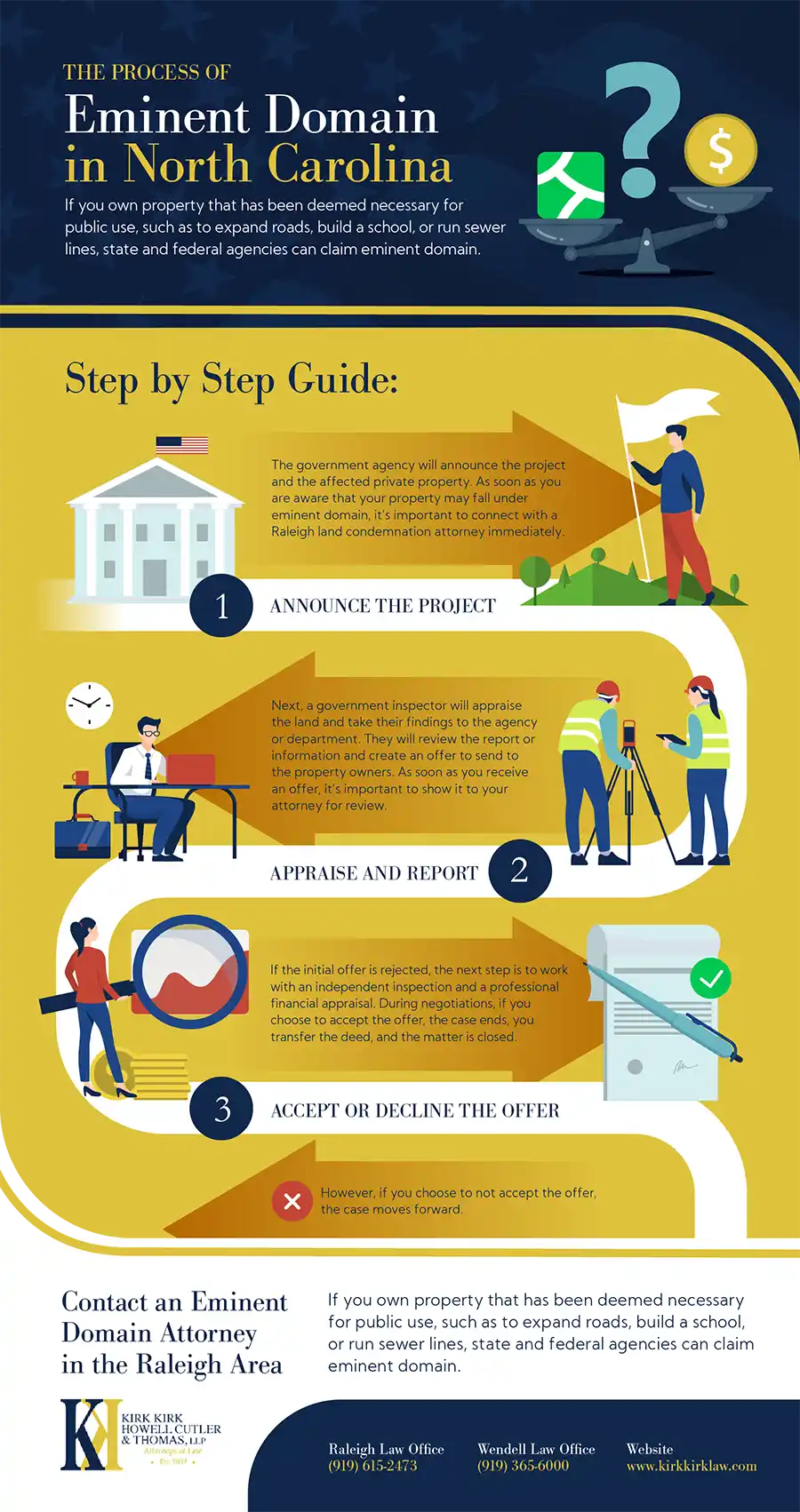
Step 2: Government Appraisal and Initial Offer
After the survey, NCDOT may evaluate the property internally or obtain an appraisal to determine the property’s value. That evaluation is then used to prepare an offer for the property owner.
A property owner has the right to reject the offer and make a counteroffer. Before making a counteroffer, it is advisable to have the proposed offer and valuation reviewed, ideally by an attorney experienced in North Carolina eminent domain and land condemnation matters.
Step 3: Independent Valuation and Negotiation
If the initial offer is not accepted, the property owner may obtain an independent appraisal or other valuation evidence and make a counteroffer. In a partial taking, the analysis may also consider how the taking affects the value of the property that remains.
During negotiations, the case is concluded by transferring the interest sought by the condemning authority through a deed and payment. However, if you choose to not accept the offer, the case moves forward.
What Happens If a Condemnation Settlement Is Not Reached?
Timing Considerations in NCDOT Condemnation Matters
Deadlines can depend on the stage of the matter. NCDOT may provide a deadline for accepting an offer. If NCDOT files a condemnation lawsuit, a property owner generally has one year within which to respond.
Because applicable deadlines can depend on the circumstances and documents involved, property owners should carefully review any notice, offer, or court filing they receive.
Impact of Eminent Domain on NC Property Owners
For property owners in North Carolina, the prospect of land condemnation can have significant financial, emotional, and practical implications. Beyond the loss of property, owners may face uncertainty about their future, disruptions to their livelihoods, and challenges in finding suitable alternatives.
Additionally, the compensation offered by the taking authority may not always reflect the full scope of loss. For that reason, property owners facing eminent domain or land condemnation should understand their rights, the procedures the government must follow, and the options available under North Carolina law.
What Rights Do North Carolina Property Owners Have in Eminent Domain Cases?
As a property owner facing the prospect of land condemnation or eminent domain, it’s important to understand that you have protections under North Carolina law. While the government has eminent domain authority for public use projects, it must follow required procedures and provide just compensation for the taking.
Right to Due Process in an Eminent Domain Case
Property owners are entitled to due process, which includes notice of the condemnation proceeding, the right to have the eminent domain case heard in court, and the right to present evidence and arguments.
Right to Just Compensation for Land Condemnation
The Fifth Amendment of the U.S. Constitution and Article I, Section 19 of the North Carolina Constitution recognize the right to just compensation when property is taken. Compensation is generally based on fair market value and may include damages caused by the taking.
In NCDOT condemnation cases, just compensation is generally determined by comparing two measures: the value of the property actually taken and the difference between the value of the entire property before the taking and its value after the taking. Generally, the greater of those two amounts is used to determine just compensation.
Right to Challenge the Eminent Domain Taking
Property owners can challenge the condemnation on multiple grounds, including the stated necessity of the project, the valuation of the property, or procedural errors by the condemning authority.
Right to Legal Representation in an Eminent Domain Proceeding
Property owners have the right to legal representation. An experienced eminent domain attorney can help protect your rights, advocate for fair compensation, and manage the deadlines and procedures in a land condemnation case.
Right to Negotiate with the Condemning Authority
Property owners may negotiate to reach a resolution. Depending on the project, negotiations may involve easements, right-of-way terms, land swaps, or other options that address the agency’s goals while limiting disruption to the property owner.
Right to Appeal an Eminent Domain Decision
If you disagree with the outcome of the condemnation proceeding, you may have the right to appeal. Appeals can challenge legal errors or unfair outcomes from earlier stages of the eminent domain process.
How Can an Eminent Domain Attorney Help a North Carolina Property Owner?
There may be no way to stop the eminent domain process once it starts, but property owners still have important rights. Having legal representation helps you understand each stage of an eminent domain or land condemnation case, including issues involving easements, right-of-way, and other factors that may affect property rights.
An eminent domain attorney in Raleigh will also look after your best interests and help reduce the pressure that can come with negotiations. While the state appraiser is acting on the agency’s behalf, we work on yours to help you pursue compensation that reflects the value of what is being taken and the impact on what remains.
Land Condemnation Attorney Philip G. Kirk
Philip G. Kirk focuses part of his practice on land condemnation and has represented property owners in condemnation matters involving public and private condemnors across North Carolina. Learn more about Philip G. Kirk’s land condemnation experience.
After you receive a notice of eminent domain, it’s important to connect with an attorney because there are actions you may inadvertently take that could affect your claim. These include:
- Filing amended property tax returns or other documents to indicate a lower property value.
- Signing documents, such as a right of access, without your eminent domain attorney reviewing them.
- Assuming you do not have rights or that it is not worth challenging the offer in a land condemnation case.
- Property owners can also learn more about common issues to consider when reviewing a North Carolina right-of-way agreement.
Potential Defenses Against Land Condemnation in North Carolina
Facing the prospect of losing your property to North Carolina eminent domain can be overwhelming, but you may have options. There are several potential defenses that an eminent domain attorney can use to challenge the condemnation action.
Challenge the Necessity of the Project
One potential defense in a land condemnation case is to challenge the necessity of the project for which your property is being acquired. This may involve questioning whether the project serves a public purpose and whether feasible alternatives exist that would avoid taking your property.
Contest the Valuation of Your Property
Another common defense is to contest the valuation of your property. The government’s initial offer should be based on fair market value at the time of the taking, but appraisals may not capture the full impact of the taking. You may have the right to present evidence supporting additional compensation, including comparable sales and expert testimony.
Assert Regulatory or Procedural Violations
Property owners can also raise defenses based on regulatory or procedural violations by the condemning authority. Examples can include failure to follow required procedures, errors in notices, or other legal issues that affect the condemnation process.
Explore Governmental Immunity Limitations
In certain situations, state or federal protections may limit a government agency’s ability to condemn specific property interests. For example, some historical or cultural protections may apply under state or federal law.
Seek Injunctive Relief
In some cases, property owners may pursue injunctive relief to halt or delay a taking while legal or factual issues are addressed. This may be appropriate when significant procedural problems exist or when irreparable harm could occur if the condemnation proceeds before issues are resolved.
Alternative Solutions and Negotiation Strategies in Eminent Domain Cases
While facing the prospect of land condemnation can be daunting, there may be negotiation strategies and alternatives that help protect your interests in an eminent domain matter.
Negotiate with the Condemning Authority
One way to protect your property rights is to negotiate with the condemning authority. This may involve working with the agency responsible for the condemnation to reach a resolution based on fair compensation and the scope of the taking.
Explore Alternative Solutions to Land Condemnation
In some situations, there may be alternatives that meet public project goals while limiting the impact on property owners. Depending on the circumstances, options may include land swaps, adjusted right-of-way boundaries, or easements that allow access without a full taking.
Consider Relocation Options
If your property is ultimately condemned, consider your relocation options. In many cases, the government is required to provide relocation assistance, which may include reimbursement for certain moving expenses and support locating comparable replacement property.
Seek Legal Counsel and Advocacy
Throughout the process, it helps to have an experienced Raleigh eminent domain attorney advocating for your interests and communicating with the condemning authority on your behalf.
Understanding Inverse Condemnation
Inverse condemnation occurs when the government takes or damages private property without paying compensation, which may allow the property owner to file a claim. It is called “inverse” because the roles are reversed, rather than the government filing an eminent domain case, the private property owner brings the claim.
Typically, a property owner may have a basis to pursue an inverse condemnation claim when there is:
- Physical occupation or seizure of property without just compensation
- A reduction in value so significant that the property is no longer commercially viable
- An unlawful quid pro quo (for example, conditioning a permit on granting an easement)
An eminent domain attorney can evaluate how the government action affected your property, whether through a direct taking, required easement, construction impacts, or economic harm, and advise you on potential compensation options.
North Carolina Eminent Domain and NCDOT Project Resources
Kirk Kirk Law provides information for property owners affected by major road and infrastructure projects throughout North Carolina, including the following condemnation and right-of-way projects.
Speak With a North Carolina Eminent Domain & Land Condemnation Attorney
At Kirk, Kirk, Howell, Cutler & Thomas, our eminent domain attorneys in Raleigh, NC represent property owners in eminent domain and land condemnation matters across North Carolina. With decades of experience, we are prepared to evaluate the taking, review the offer, and help you understand options for pursuing fair compensation.
If you’re facing eminent domain proceedings, contact us for a consultation and case review to discuss your situation and next steps.
Get started today by calling our Raleigh law firm at (919) 365-6000 or filling out the contact form below.

Request a Case Review from Our Raleigh Lawyers
We’re here to help.
Contact us and we will be in touch.
Phone: (919) 365-6000
Our Office:
200 North Pine Street
Wendell, NC 27591